Chemical Protective Coverall for Acid Splash Protection: Key Selection Factors
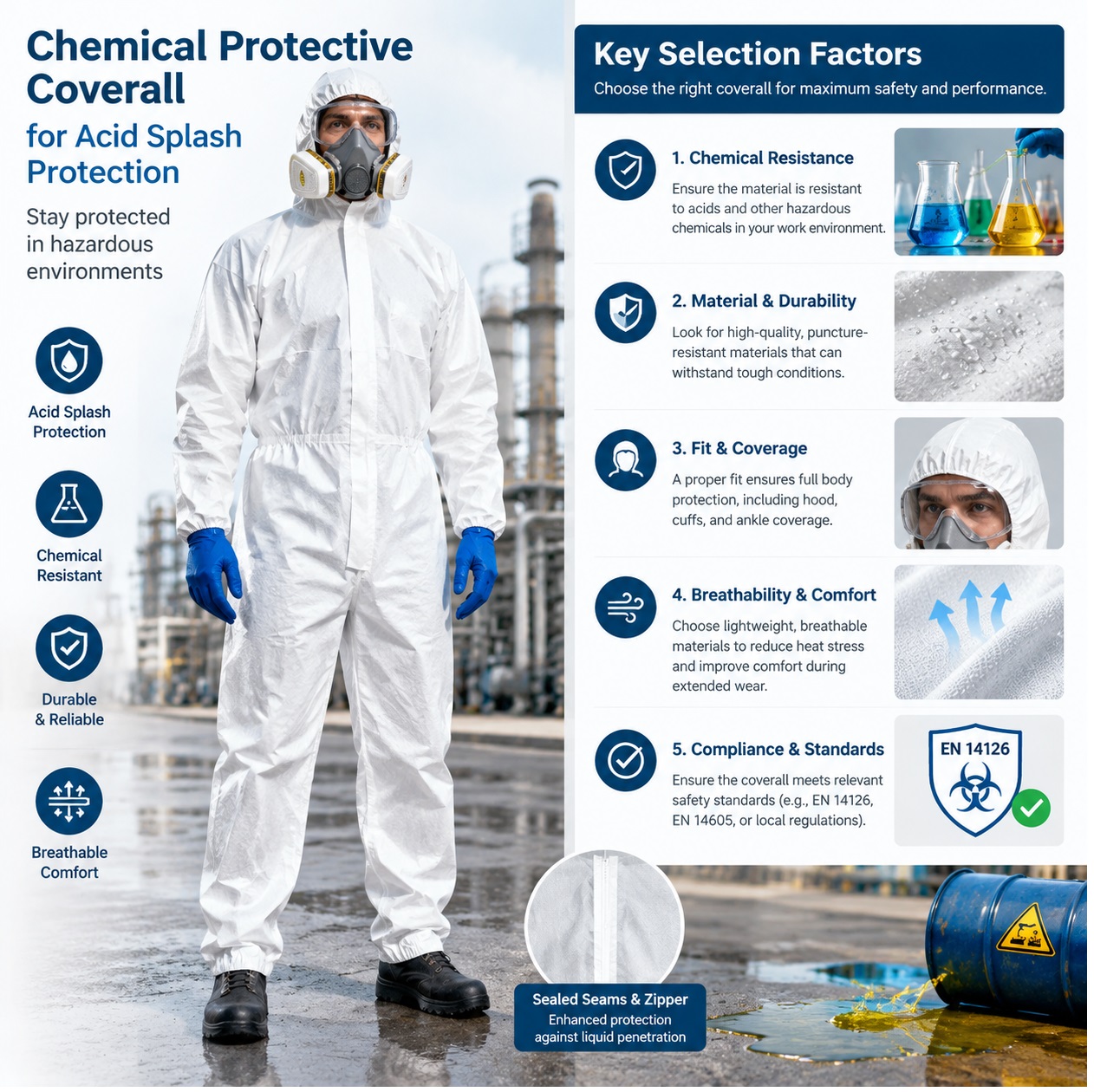 A single splash of concentrated sulfuric acid can eat through a cotton shirt in under ten seconds. That number alone explains why chemical protective coveralls are not a commodity purchase. They are a last line of defense, and the wrong one can turn a routine maintenance job into a hospital visit. But walk into any safety equipment catalog and you’ll find dozens of options, all claiming acid protection, all looking roughly the same in the product photo. The differences that matter are buried in fabric specs, seam construction, and test data that most buyers never read carefully enough. Here’s what actually separates a chemical protective coverall that protects from one that just looks the part.
Start with the fabric, because everything else is secondary. Acid protection isn’t a single property. It depends on the specific chemistry of the acid, its concentration, and whether you’re dealing with liquid splash, vapor, or pressurized spray. A coverall that shrugs off dilute hydrochloric acid may fail quickly against chromic acid or hydrofluoric acid. This is why generic claims like “acid resistant” mean almost nothing. You need permeation data for the specific chemical you’re handling. Permeation breakthrough time is the number that matters: how many minutes before the chemical passes through the fabric and reaches the wearer. For splash scenarios, a breakthrough time of more than 30 minutes is often considered a reasonable benchmark, but higher-risk acids demand longer margins. If the manufacturer can’t provide chemical-specific permeation testing, that’s your first red flag.
Material choice follows directly from that data. Multi-layer films and laminates, often based on polyethylene or specialized barrier films, tend to offer the broadest chemical resistance with relatively low weight. PVC-coated fabrics are heavier and less breathable but excel against many concentrated acids and are popular in industrial maintenance. Neoprene and butyl rubber offer strong resistance to specific acid families but come with their own trade-offs in flexibility and heat retention. There’s no universal winner. The right material is the one whose permeation profile matches your actual chemical exposure, not the one with the most impressive marketing sheet.
Seams are where good coveralls quietly fail. A fabric can hold up beautifully while the stitching pulls apart or wicks liquid straight through the needle holes. Look for seams that are welded, taped, or otherwise sealed rather than simply stitched. Serged seams are common in low-cost garments and are fine for dry particulate protection, but they are a liability against liquid acid splash. If the product description doesn’t specify seam type, assume the cheapest option was used. This single detail separates disposable-grade coveralls from genuinely protective ones, and it’s frequently the difference in price between a garment that passes a splash test and one that doesn’t.
Then there’s the closure system. Zippers alone are not enough. A proper acid splash coverall uses a zipper with a storm flap, often double-flapped, and ideally with adhesive tape over the closure for higher-risk tasks. The flap should extend past the zipper on both sides and lie flat against the body. Velcro over a zipper is common, but Velcro can clog with debris and lose grip over time, so inspect the design with repeated use in mind. Cuffs and ankles deserve the same scrutiny. Elastic cuffs are comfortable but can ride up; integrated thumb loops or boot flaps keep the garment in place when a worker bends or reaches. Any gap at the wrist or ankle is an entry point for liquid running down a sleeve or leg.
Fit is not a comfort issue. It’s a safety issue. An oversized coverall snags on equipment and creates folds where acid can pool. An undersized one restricts movement and tears at stress points. Most manufacturers publish size charts based on height and chest measurement, but if you’re layering the coverall over street clothes or other PPE, size up accordingly. Pay attention to the torso length as well. A coverall that rides up when the wearer raises their arms exposes the lower back, which is exactly the kind of gap that turns a small splash into a serious burn.
Don’t overlook the accessories and the full ensemble. A coverall is one component. Chemical-resistant gloves, boots, face shields, and respiratory protection all interact with it. Gloves should overlap the sleeve cuff, not tuck under it. Boots should be worn outside the coverall leg or with the leg properly sealed over them, depending on the design. If the coverall has a hood, check that it fits over a hard hat without pulling the fabric tight across the shoulders. The weakest point in any ensemble dictates the overall protection level, and a great coverall paired with the wrong gloves is still a failed system.
Finally, consider the practical realities that don’t show up on a spec sheet. How long will the coverall be worn? Heat stress is a genuine hazard with low-breathability barrier fabrics, and workers who overheat make mistakes. Disposable versus reusable matters too. Reusable garments need inspection and cleaning protocols between uses, and contaminated coveralls require proper disposal procedures. If your team won’t realistically follow those protocols, a single-use option may be the safer operational choice even if it costs more per wear.
Choosing an acid splash coverall comes down to matching specific chemical hazards with verified permeation data, sealed construction, and a fit that holds up under real movement. The best coverall isn’t the most expensive or the most heavily marketed. It’s the one whose protection claims you can trace back to test results, and whose design accounts for the way people actually work. Get those factors right, and the garment does its job quietly. Get them wrong, and you find out the hard way